A pragmatic owner in a crisis does one thing first: they stop protecting the image and start protecting the company.
They stop asking how to avoid the conversation and start asking who they need in the room. They accept that the people who helped build the company may not be the ones who can save it. And they find someone who has no stake in the illusion, someone ethical, honest, and objective, who can help them navigate what is real.
That is the hardest step. Almost none of us take it early enough.
Here is why.
No one pushing from outside
Picture a large public company in trouble. People outside the building notice fast. Shareholders ask questions. Regulators demand answers. Journalists write about it. All of that outside pressure forces the company to act quickly. Waiting stops being an option.
A family business has none of that. There are no shareholders outside the family, no regulators watching, and no journalists calling. The family is entirely on its own to decide what to say, what to shield, and how long to wait.
And because we want to protect what we've built, we almost always make the same decision: not yet.
With nobody forcing a change, "not yet" becomes the default answer, month after month. But while we wait for the perfect moment to act, the problem quietly keeps growing.
The aura of normality
When you build something real, the company carries your name, often representing the hard work of three or four generations. Admitting that something is seriously wrong feels like admitting you personally failed.
So, we do what any protective leader would do: we try to shield the people around us. We keep quiet. We don't want to worry our suppliers, panic our clients, or bring the stress home to the dinner table.
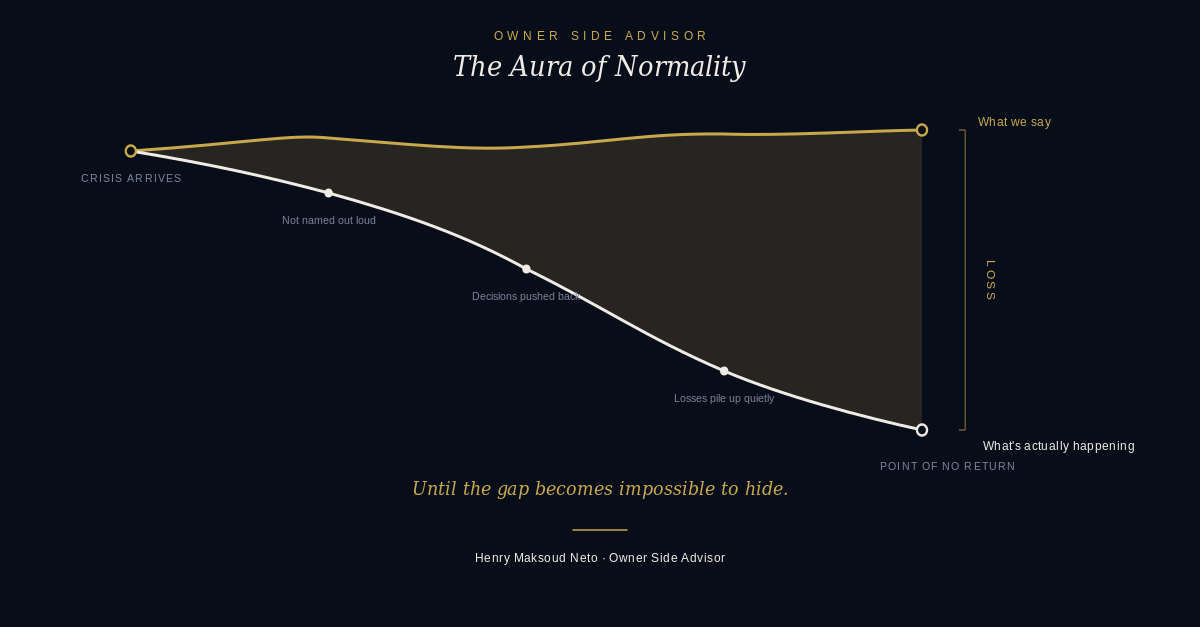
But that protective silence is exactly what builds the aura of normality: the quiet agreement that everything is fine, we are working on it, something will turn up.
What turns up, most of the time, is just more debt.
This aura isn't built by the family alone. I have seen entire management teams build it together, living inside it as if by unspoken agreement. Salaries start arriving late, then later still, yet leadership keeps running the business as though nothing has changed. Nobody stands up in the meeting to say the obvious. Everyone finds their own way to rationalize it, until a late salary feels normal and no one is tracking how far the ship has actually drifted.
When things get hard, our natural instinct is to lean on the people who have been there the longest, the most loyal ones. That instinct comes from a good place, but loyalty and clear sight are two very different things. A manager who spent fifteen years helping build the company often cannot separate what the business used to be from what it actually is today.
Some of these people will fight harder than anyone to turn things around. Others, without meaning to, keep the aura alive simply because admitting how bad things are would mean admitting they missed the warning signs, too.
I once saw a retail business in the middle of a serious cash crisis spend weeks deciding which new products to launch. The money was running out, suppliers were getting nervous, and the family's answer was to plan for growth. They were not being careless. They genuinely believed the next big launch would fix the problem.
In their hope, they had confused a deep, structural cash problem with a temporary sales glitch. That belief, held just a little too long, is how a solvable problem quietly becomes an impossible one.
The pattern is incredibly subtle: the crisis arrives, we feel it, but we don't name it out loud. The decisions that need to happen today get pushed to next month. The company keeps running, but underneath, the foundation is eroding. Clients sense the tension and leave. Suppliers demand payment upfront. The losses pile up quietly, until they are no longer quiet.
And then, the worry shifts from saving the company to a much heavier, personal fear: what is going to happen to my family?
Looking for a hero that doesn't exist
Somewhere in the middle of this pressure, it is natural to start looking for a rescue. Not a complex restructure, but a savior. Someone who will walk in, understand everything instantly, and make the pain go away without anyone having to change how things are run. A genius investor. A miracle buyer. A distant relative who made a fortune elsewhere.
Wanting someone to share this heavy lifting is entirely natural. It isn't weakness, it's survival.
But that perfect savior does not exist. What does exist is hard work, honest numbers, and finding someone willing to sit beside you and help you see clearly. It is a far less exciting answer than a hero, but it is the only one that actually works.
The biggest risk of all
What makes this so dangerous is that most owners have no idea how close to the edge they actually are. We tell ourselves we are just navigating a difficult season. What we are actually doing is taking on massive personal risk without realizing it.
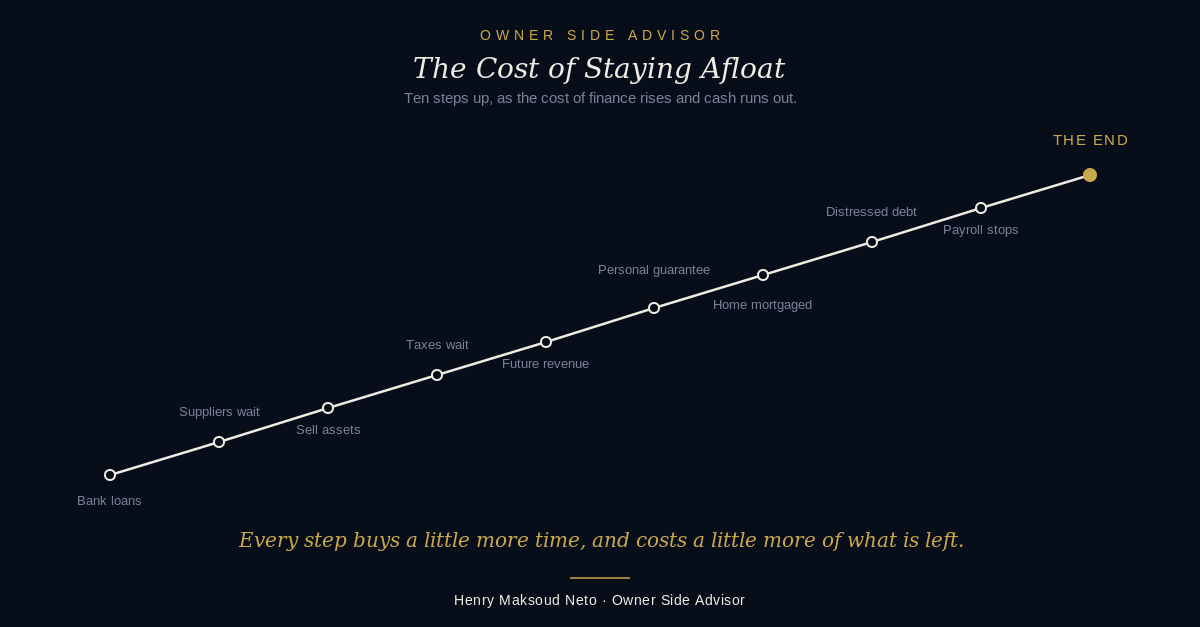
To keep the business breathing, we start putting personal assets on the line: a house offered as collateral, a personal guarantee attached to a loan, an unlimited indemnity signed almost as a formality because the bank asked for it and we were too focused on meeting payroll to think it through.
Each one, on its own, feels like a small, reasonable step to buy a few more months. Together, they quietly cross the firewall between corporate liability and personal ruin. It turns a company problem into a systemic family crisis, the kind that follows you home and outlives the business itself.
And then the opportunists arrive. They always do. People who sense weakness and show up with solutions that benefit them far more than you.
What I lived
I am not describing something I read in a textbook. I lived this. My family's company had more than fifty years of history when the crisis hit. I know exactly what it costs to keep up the aura of normality for too long. I know what it feels like when every crushing decision has nowhere to land except on your shoulders. And I know the pain of looking back and realizing the moment to act has already passed.
The most valuable thing an owner can do in a crisis is stop pretending the crisis is not happening.
Pragmatism doesn't mean having all the answers or a perfect strategy. It just means having the courage to look at the situation as it actually is, not as we hoped it would be.
This is part of why the owner's seat gets so lonely. I wrote about that isolation directly in my piece, That Is the Loneliest Place on Earth, because I know exactly where that silence leads.
If you are running a family enterprise and see your own boardroom in these lines, let's have an honest, confidential conversation. The window to act is shifting. Let's look at what is real, together, before the choices are made for you.