Picture an ordinary meeting. Four professionals, four opinions, all of them competent.
The lawyer recommends holding the position. The tax advisor recommends a different structure. The banker recommends waiting for better conditions. The consultant recommends a review.
Everyone speaks well. Everyone is right inside his own subject. The meeting ends on time, and each of them leaves with a recommendation delivered and a job well done.
The consequence gets in the car with you.
Two different products
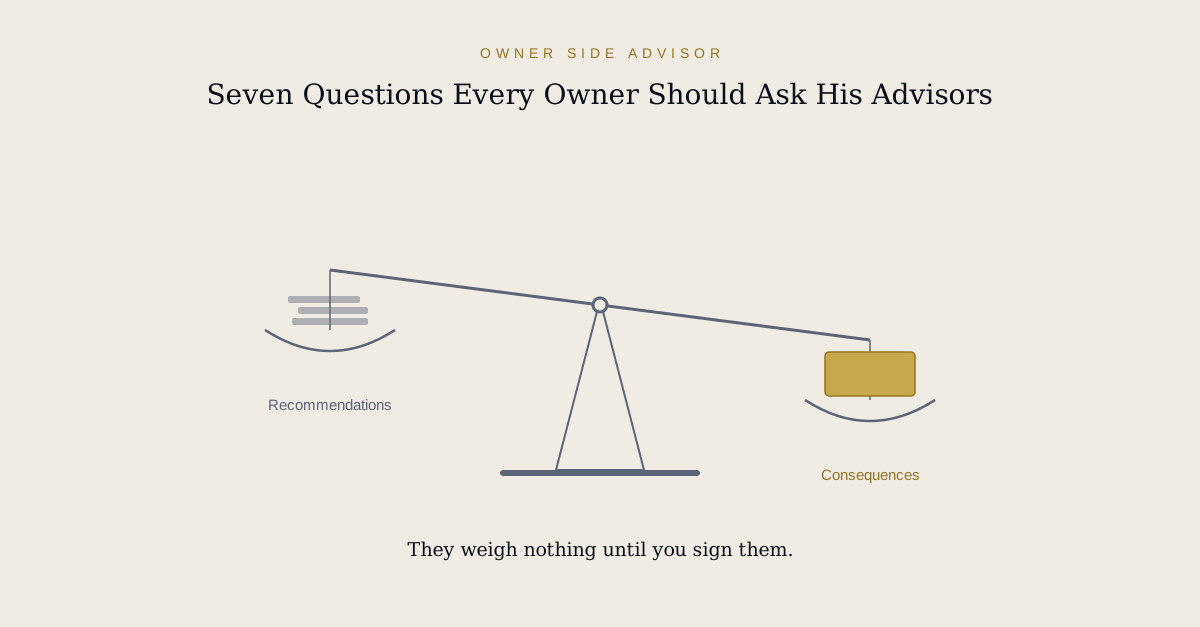
Advisors produce recommendations. Owners produce consequences.
The words sound close and they are not. A recommendation is a professional opinion, given in good faith, measured by whether it was reasonable at the time it was given. A consequence is what actually lands on your company, your balance sheet and your family.
Nobody is behaving badly here. Your advisors are doing exactly the job you hired them to do. It is simply not your job.
They are graded on the quality of the recommendation. You are graded on the result.
That difference is the whole reason owners have to govern their advisors, and it has nothing to do with mistrust.
Governing is not distrusting
I want to be clear, because this is where owners get uncomfortable.
Governing your advisors does not mean doubting them, checking their work, or pretending you know their subject better than they do. You do not, and you should not want to.
It means shaping what comes back to you, so that opinions arrive in a form you can actually decide on.
Most owners never do this. They receive recommendations in the shape the advisor prefers to give them, which is usually technical, cautious and unpriced. Then they wonder why deciding feels so hard.
Seven questions that change what you receive
None of these require any technical knowledge. They work in law, in tax, in banking and in everything else.
What would you do if the money were yours? You will often get a different answer from the official recommendation. Not because anyone was hiding anything, but because professional advice is written to be defensible, and personal advice is written to be right.
What did you reject before you brought me this? Every recommendation has a discarded twin. Knowing what was considered and dropped tells you more about your real position than the proposal itself.
If this goes wrong, what happens, when, and who pays? Limited risk is not an answer. Convert it into your currency: how much, in which year, out of whose pocket. An advisor who cannot answer that has given you an opinion, not a plan.
Can I repeat this to someone outside the business? If you cannot explain the choice in your own words to an intelligent person who knows nothing about your company, you have not understood it yet, and you are not ready to sign it.
Tell me the story before you tell me the answer. Ask any new professional to narrate how you arrived here, briefly, in his own words. If he cannot, his recommendation is about the file, not about your situation.
Have you spoken to the others? Recommendations that never meet each other quietly contradict each other, and you pay for the contradiction. Make them talk. It is your table.
By when? Advisors have no clock. You have one. A decision that stays open is not being postponed. It is being made slowly, and expensively, by everybody else.
The part nobody can do for you
There is one step in this chain that cannot be delegated, and it is not the technical work.
It is turning several good recommendations into one decision.
That step has no owner unless you give it one. The lawyer will not do it, because it is not his subject. The banker will not do it, because he sees one side. The finance director will not do it, because he cannot overrule the family.
So it either sits with you, on top of everything else you are carrying, or you give it to somebody whose actual job is that: holding the whole picture, making the specialists work with each other rather than in parallel, and bringing you choices instead of opinions.
That is the work I do, and I arrived at it the slow way. I did that job for my own company for years without the title, and I would have paid well to have someone else doing it.
One last thing worth remembering
In five years, your advisors will not remember this matter.
That is not a criticism. They will be on other matters, for other clients, and their memory of yours will fade the way anybody’s does. Some will have changed firms. Some will have retired.
You will remember it perfectly, because you are the one who lived the consequence.
Govern them with that in mind. Ask the seven questions, write down why you decided what you decided, and keep beside you at least one person who is still going to be there when the rest of the room has moved on.
A conversation
If you are in that seat now
Maybe you saw yourself in this. Or someone you know.
I sat in the owner's chair for twelve years, and nobody sat next to me. Now I sit next to owners who carry the last decision.
It starts with one conversation. You tell me where you are. I tell you honestly if I can help. If I cannot, I will tell you that too.
It stays between us.