Every business owner meets this man at least once.
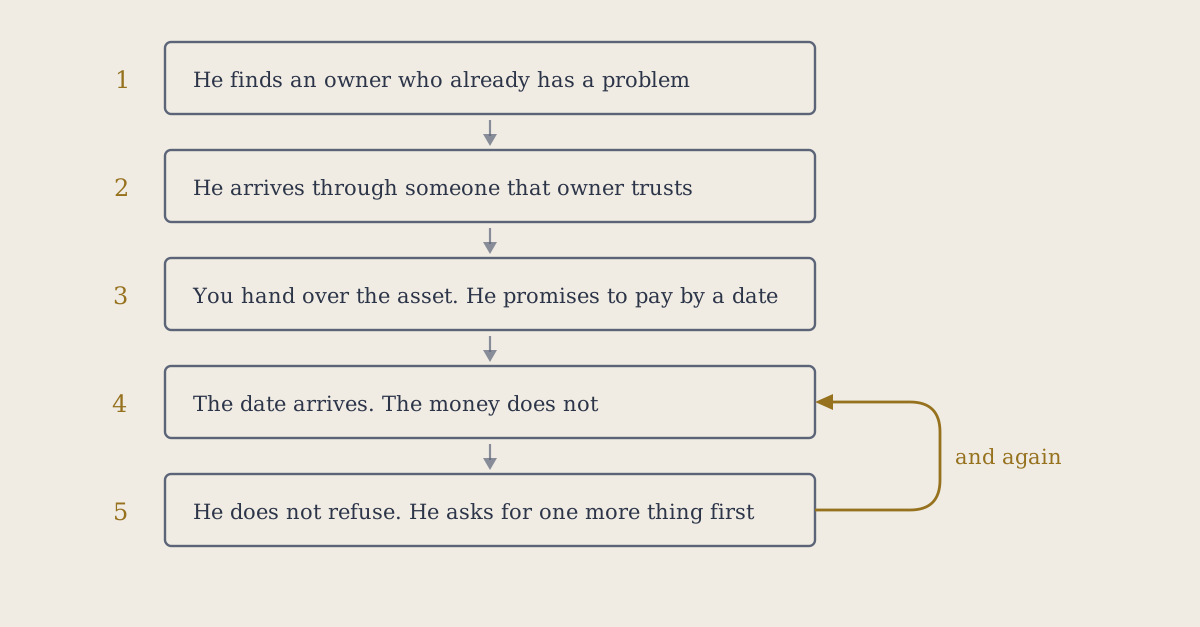
He comes recommended, and the references are real. He offers to take something off your hands. The stock, the equipment, the building, the receivables, a piece of the company. He does not argue much about the price. He argues about the terms, and he argues hard.
He will pay you when he sells it. Or he will pay you more, later, once the price improves. Or he will pay you as soon as his own deal closes. There is always a date, and he is the one who gives it.
He takes the asset. The payment is always in the future.
Two years later he has your asset. You have his promise. And every time you ask for the money, the promise costs you one more thing.
What due diligence does not check
Due diligence checks facts. It confirms that the company is registered, that the accounts add up, that the lawsuits were declared.
It does not tell you what the man will do when his turn comes.
That is the part that costs money. Most losses do not come from a fact nobody checked. They come from a man who was always going to act this way when it was his turn to pay.
Warren Buffett said it in one line: “You can’t make a good deal with a bad person.” He also says the contract will not save you. A man who breaks his word is comfortable in court. You are not.
He looks for an owner with a problem
He is not looking for everyone. He is looking for an owner who already has something going wrong.
A bank that has stopped being friendly. A partner who wants out. A tax assessment. A deal that has to close before the quarter ends. A family that has stopped talking.
The choice is not random.
An owner with a problem wants a solution, not a warning. He is in a hurry, and people in a hurry do not check. The problem is private, so he asks two people about the man instead of ten. He is grateful that somebody has finally offered to help, and gratitude makes him go first. And if it ends badly, he cannot afford a long fight. That last point is why he was chosen.
He arrives through people you trust
He does not approach that owner cold. He arrives through someone the owner respects, and usually because of the problem itself. A friend who means well hears what you are facing. He tells you he knows the right man for it.
That introduction is what the whole thing rests on, and the good intention behind it is what makes it work.
The names around him are real. The lawyer is a real lawyer. The bank is a real bank. The friend who mentioned him is a real friend who means you well. None of them are part of it. They are being used the same way you are about to be used, and most of them only hear about it much later.
What he gets from those relationships is your decision not to check. An introduction from someone you trust does the job that due diligence should do, and it does it in four seconds.
Then it works a second time, in the wrong direction. You do not want to insult your friend by asking hard questions. Later you do not want to embarrass him by pulling out. The relationship that brought the man in becomes the reason you stay in.
There is one question that costs nothing. Ask your friend if he has done business with this man himself, with his own money, and how it ended. Very often the answer is that they have never done a deal together.
Four signs, and they come early
He is relaxed with your money and careful with his own. Watch what he is willing to risk before anything is agreed. This sign predicts all the others.
He is inaccurate about small things. A man who is careless with a small fact that costs him nothing will be careless with a big one that costs him a lot.
Every past partner was the problem. If every deal he describes ended because the other side was difficult or dishonest, you are hearing the story he will tell about you.
He talks about his own character. His word, his reputation, the fact that he has never let anybody down. It comes up early, and nobody asked him. In a normal negotiation nobody raises it.
How it actually goes
Nothing goes wrong at the start. The first arrangement looks like any other.
It has one feature you do not notice at the time. You go first. Your goods, your equipment, your building, your money, your signature. His part comes later, and later always sounds reasonable.
Think back to how the terms were agreed. That part was not easy. He was firm. He was offended. He threatened to walk away over a clause. He called late at night to reopen a point that was already closed.
That is the moment the deal starts to look real. Nobody fights that hard over something he does not take seriously, and after a negotiation like that you stop asking yourself whether the man is genuine.
The terms cost him nothing. He does not intend to follow any of them. The clause he fought hardest for is the one he will break first, and the fight was never about the clause. It was about being believed.
Then his turn arrives and nothing happens. He does not refuse. Refusing would end it. He gives a reason, and the reason is often true. The bank is slow. The partner is travelling. The money comes when the quarter closes.
Then comes the sentence that changes the arrangement. He will pay, as soon as one more thing happens. One more piece of work. One more month. One more introduction. One more payment. The promise is still there. Only its price has moved.
That is the whole method, and it repeats for as long as you allow it. You do the extra thing because the end looks close. You also do it because stopping now would waste everything you have already put in. Each round he owes you more. Each round you need him to pay more than you did before.
There is a reason the extra thing never ends. The money on his side usually never existed. He was always going to pay you with what he got for selling what you gave him. By the time he sold it, that money had gone somewhere else. He cannot pay, so he keeps the conversation going instead. Every new condition buys him a few more months.
He never has to force you. You do it to yourself, for a reason that sounds sensible every single time.
A new condition attached to an old promise is not a delay. It is the answer.
A man who means to pay, pays. If he needs something else from you, he asks for it separately, as a new deal.
There is one more move, and it comes when you stop being patient. You ask for the payment plainly, and the subject changes. He is hurt by the question. After everything he has done, this is what you think of him.
Now the conversation is about your manners, not about the money. Many owners end that call apologizing, and the payment is exactly where it was.
Asking a man to pay what he owes is not an accusation. It is the normal end of a deal. A man who means to pay answers the question as a normal question.
Buffett often repeats a hiring test he heard from somebody else: you look for integrity, intelligence and energy, and if the person does not have the first, the other two will kill you. Ability is not a comfort here. A capable man is given more, and given it for longer, before anybody asks a hard question. That is what makes the loss bigger.
Why owners keep going
Almost every owner this has happened to says the same sentence afterwards. He knew something was wrong. He usually did.
Money and months had already gone in, and stopping meant admitting they were lost.
Charlie Munger’s rule applies here as much as anywhere. Show me the incentive and I will show you the outcome. The owner who most needs the deal to work is the one least able to look at it coldly.
What to do when you see it
Buffett is fond of an old rule: the most important thing to do when you find yourself in a hole is to stop digging.
So stop. Do not do the extra thing to unlock the old promise. Doing it does not produce the payment. And do not try to fix it with a better contract. That is a fence built around a man you have already decided you cannot trust.
Give him nothing new. No more money, no more work, no more authority, no introduction to anyone who matters to you. Treat what you have already spent as gone, because it is. It should play no part in what you decide next.
Then tell the person who introduced him, plainly and without accusation. The man reached you through that door. The next owner will be reached through the same one.
And structure the next deal differently. Either his part comes first, or both parts happen on the same day.
The half of this that is about you
Charlie Munger described the best way he knew for people to work together: “The highest form that civilization can reach is a seamless web of deserved trust. Not much procedure, just totally reliable people correctly trusting one another.”
Serious people are running the same checks on you. They notice whether you did what you said when it was expensive to do it.
A reputation for keeping your word is not good manners. It is access to the small group of people who also keep theirs. That is the only real protection there is in business.
The decision nobody can make for you
Your lawyer will tell you what the contract says. Your banker will tell you whether the numbers work.
Not one of them will tell you that the man across the table is never going to pay you. It is not their subject, and it is not their money.
So the judgment stays with you, and you have to make it before you have proof. Character cannot be verified. It can only be watched, and the watching starts in the first meeting.
A conversation
If you are in that seat now
Maybe you saw yourself in this. Or someone you know.
I sat in the owner's chair for twelve years, and nobody sat next to me. Now I sit next to owners who carry the last decision.
It starts with one conversation. You tell me where you are. I tell you honestly if I can help. If I cannot, I will tell you that too.
It stays between us.