Warren Buffett said it in one line. “You can’t make a good deal with a bad person.”
I agree with every word. It is my north in everything I do.
For me, integrity is not negotiable. Neither is honesty.
Many owners learn this late. They learn it after the contract is signed. After the money is gone. After their name is tied to someone else’s problem.
Integrity comes before everything else
A person without integrity is like a cart without the pin that holds the wheel. It looks like a cart. It goes nowhere.
Buffett looks for three things when he hires. Integrity, intelligence and energy. If a person lacks the first, he warns, the other two will kill you.
Think about that. A smart person without integrity is more dangerous than a foolish one. He is better at hiding. An energetic person without integrity does more damage, and faster.
So talent is not a comfort. Talent without integrity is a risk you are paying for.
In a family business this matters even more. Owners often trust people because they are close. A long friendship. A family tie. A man who has been there for years.
None of this proves integrity. It only proves time.
Reputation is the real balance sheet
A reputation takes a lifetime to build. It can be lost in one afternoon.
A family business carries a name. Often it is the family’s own name. Banks lend on it. Partners sign on it. Employees stay because of it.
When Buffett took over Salomon Brothers in 1991, the bank was in scandal. He told the staff: “Lose money for the firm and I will be understanding. Lose a shred of reputation for the firm, and I will be ruthless.”
There is an old test for every decision. Would you be happy to see it on the front page of tomorrow’s newspaper? Read by your family and your friends?
If the answer is no, do not do it.
What you do when nobody is watching
Integrity is easy in the meeting. Everyone is watching.
So ask yourself one question. Would you behave the same if nobody could ever see you? If nobody would ever find out?
That is the real test of integrity. Not what you do in the meeting. What you do after it. When the other side trusted you.
The rule is simple. Do not do what is not right. Do not say what is not true.
Two sentences. Enough for a whole life.
Dishonesty hides in small details
Dishonesty rarely arrives as a big crime. It comes in small details.
A line in a contract, written to hurt the other side. Placed on page 40, where nobody reads. Legal, maybe. Honest, never.
Gossip about a partner who is not in the room. A few words over dinner. It costs nothing to say. It can cost him his name.
A small dishonorable act. A promise kept only on paper. A payment delayed on purpose, because the other side cannot fight back.
Each one looks small. Together they show who a person is.
Silence is also a choice
There is another kind of dishonesty. It is quieter. It is doing nothing.
Desmond Tutu said: “If you are neutral in situations of injustice, you have chosen the side of the oppressor.”
Think of the board member who sees a partner being cheated and says nothing. The advisor who sees it and looks away. The family member who stays quiet to keep the peace.
Sometimes silence protects the peace. But when it lets real harm continue, it becomes part of the problem.
They did not do the wrong thing. But they let it happen. And the person who was harmed will remember who stayed silent.
John F. Kennedy liked to say it this way, paraphrasing Dante: “The hottest places in hell are reserved for those who in a period of moral crisis maintain their neutrality.”
To betray someone who trusted you is one of the oldest wrongs there is. To watch it happen and say nothing is not far behind.
Closing your eyes to betrayal is not neutral. It is a small part of the betrayal.
In negotiation, character is part of the deal
Most owners study the numbers. The price. The terms. The guarantees. Very few study the person across the table.
This is a mistake. A contract is only as good as the person who signs it. A dishonest partner will find the gap in any clause. Contracts and good lawyers matter. They do not replace character.
So before I look at the terms, I look at the history. How did this person treat his last partner? His employees? His creditors? What do people say about him when he is not in the room?
If the answers worry me, the price does not matter. A great price from a bad person is not a great deal. It is a delay before the problem.
Walking away is also a negotiation skill. Maybe the most important one. The bad deal you did not sign cannot hurt you.
Rising by pushing others down
There is a kind of person every owner meets. He does not build. He climbs. And he climbs on other people.
He takes credit for work he did not do. He blames others for his mistakes. He uses a partner’s weak moment to change the terms. He makes a colleague look small so he looks big. He treats people as steps on a ladder.
Business runs on trust. Trust runs on fair treatment. The man who wins by making others lose does not only hurt his victim. He makes everyone around him trust a little less.
And he will do it to you too. It is only a matter of time. If he talks badly about his last partner to you, he will talk badly about you to the next one.
The wolf comes in the old lady’s clothes
Here is the part I want every owner to remember.
Bad people rarely look bad. If they did, nobody would fall for them.
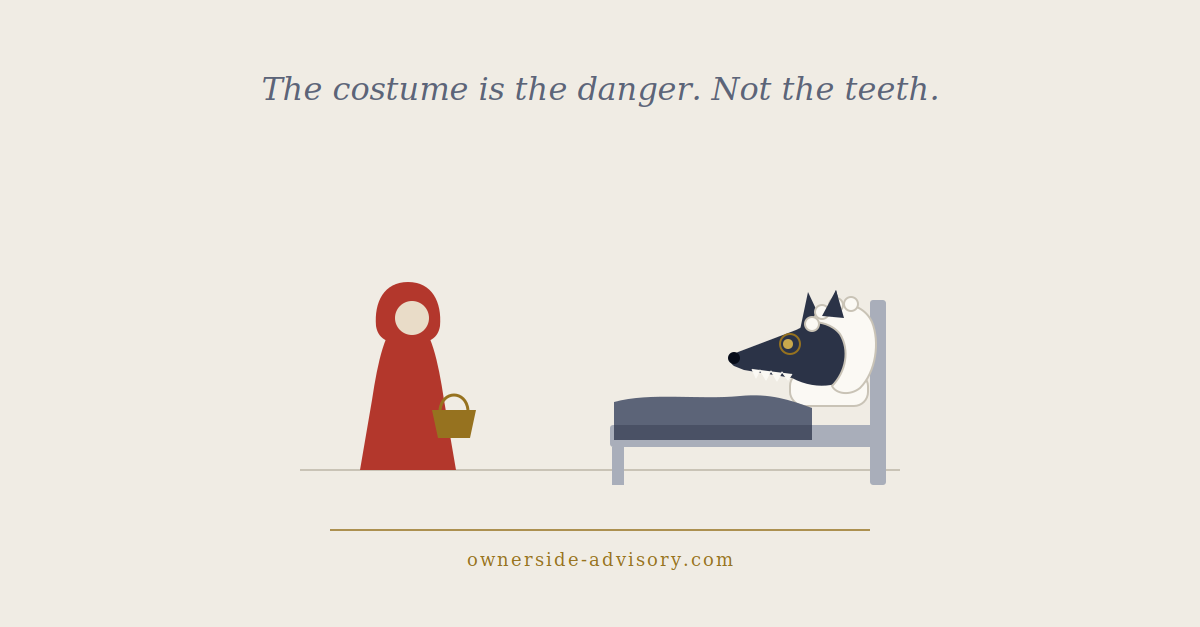
Think of Little Red Riding Hood. The wolf does not knock as a wolf. He waits in the grandmother’s bed. He wears her clothes. He speaks softly. The girl notices something strange. The big eyes. The big teeth. But she stays, because the clothes are familiar.
Business works the same way. The wolf arrives as the helpful friend. The generous investor. The advisor who agrees with everything you say. The buyer who offers more than anyone else and wants nothing in writing.
Watch for the signs. An offer that is too good. Pressure to decide fast. A request to keep things from your other advisors. Charm that grows when you ask hard questions. A story that changes a little each time.
The more attractive the offer, the more carefully you should look.
The costume is the danger. Not the teeth.
Deserve what you want
Charlie Munger gave the other side of the lesson. “The safest way to try to get what you want is to try to deserve what you want.”
This is not only about avoiding bad people. It is about being a good one.
If you want loyal partners, be a loyal partner. If you want honest employees, pay them honestly and on time. If you want banks to trust you, tell them bad news early.
It sounds simple. It is not easy. There will be moments when a small lie would solve a big problem. When cutting a corner would save the month.
Those moments decide who you are. And people notice. They always notice.
It pays back anyway
Some people think integrity is expensive. That honest people finish last.
I believe the opposite. When trust is high, deals move fast and cost less. When trust is low, everything slows down. Every step needs a lawyer, a guarantee, a second check.
Integrity pays back. Not always fast. Not always in the same deal. But it pays back.
The honest owner gets the second call. The good partner gets the next opportunity. A name protected in a hard year opens doors ten years later.
A company where people can trust each other is worth more than any contract. The same is true for a family. And for a life.
Trust is not given. It is deserved. It is built slowly, one kept promise at a time.
There is no other way to live. Not one that lasts.
A conversation
If you are in that seat now
Maybe you saw yourself in this. Or someone you know.
I sat in the owner's chair for twelve years, and nobody sat next to me. Now I sit next to owners who carry the last decision.
It starts with one conversation. You tell me where you are. I tell you honestly if I can help. If I cannot, I will tell you that too.
It stays between us.