The wall in front of me
I was not the Principal when our family's most important asset went to auction in 2011 to pay debts I had no part in creating. My grandfather held that seat. The legal fight was his to lead, not mine.
But I remember the exact moment where I was when I understood something had shifted in me. From that day on, this could not be someone else's fight. It had to be mine too.
When you find a wall in front of you, you do not turn back. You bring it down, or you go over it, around it, or through a door nobody else has noticed yet. But you keep moving forward.
Ten years of what has to be done
My grandfather passed away at the beginning of 2014. It took until 2021, ten long years, to reach a final agreement. Ten years of doing what has to be done, within whatever power I actually had that day. Sometimes that meant paperwork. Sometimes it meant sitting across from the people who held real power over the outcome, whenever they agreed to see me, and making the case myself, in person, for why we deserved a different result.
In the middle of that storm, I was not just managing a legal dispute. I had to execute a complete operational turnaround while simultaneously facing USD 250 million in debt and liabilities.
They do not teach you how to navigate true existential crises in business school. Traditional management training prepares leaders to optimize systems, scale growth, and execute steady-state strategies. It does not prepare them for the disorienting, non-linear pressure of systemic collapse. When a crisis threatens the very foundation of an enterprise, even highly accomplished executives freeze. It is not a failure of intelligence or character: it is simply that standard corporate playbooks offer no guidance when the ground disappears beneath your feet.
When I share what I have been through, people often look at me and say, "I am sorry to hear what you went through."
And I smile.
They hear hardship, but to me, it was where I found my footing. Challenge is the environment where I work best. What keeps me moving forward every single day is a focus on resolving what seems unresolvable: I genuinely love solving deadlocks.
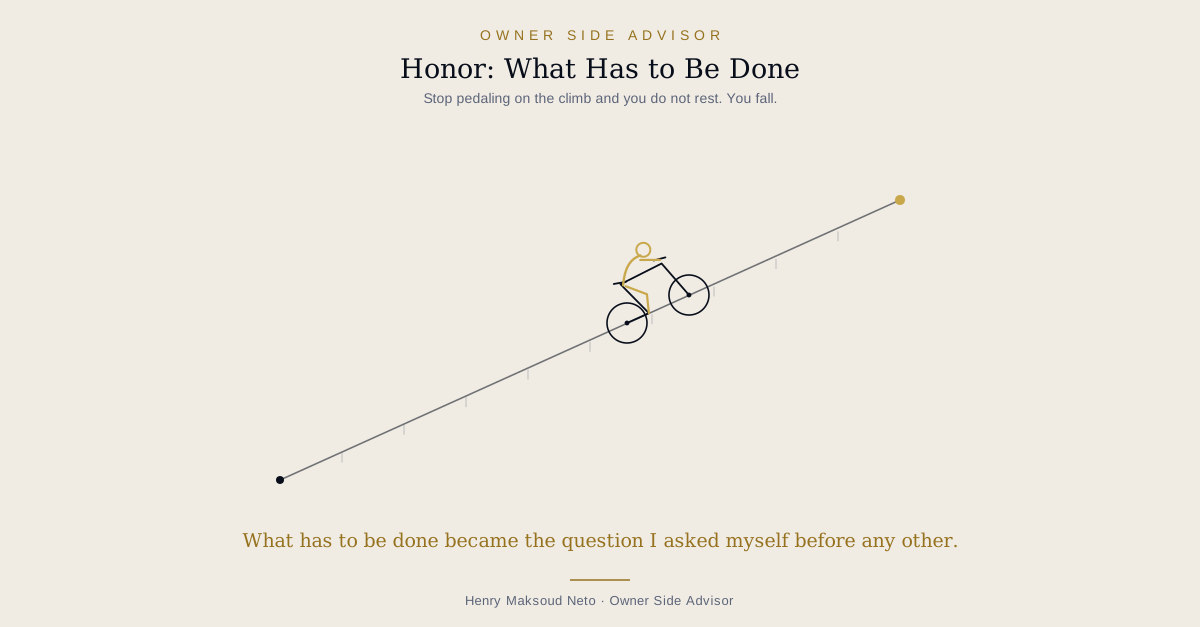
Somewhere in those years, someone compared what I was doing to a cyclist climbing a mountain: stop pedaling on a climb and you do not rest, you fall. That image stayed with me, but over time I learned what real momentum requires. It is not frantic action or rushing every decision. It is the absolute refusal to stall. Sometimes pedaling means immediate execution. Sometimes it means having the discipline to hold your position until the path opens up. What matters is never abandoning the climb.
What has to be done became the question I asked myself before any other. Not what I felt like doing. Not what was easiest. What the problem in front of me actually required.
Even now, on ordinary mornings, while I am doing something as simple as razor shaving my beard, I run the same question for whatever is on my desk that day. What does this specific problem need from me. That is not a mood. It is a discipline, repeated at the same unremarkable moment, every day, whether I feel like it or not.
Putting order on chaos
Somewhere along the way, converting chaos into structure stopped being a burden and became my core purpose. I do not look for the fight, but I am entirely at home in it.
Eventually, that focus became a practice. Owner Side Advisory exists because of that ten year fight, not despite it. I built it not to prolong the tension, but to resolve it: standing beside owners in their hardest moments to restore order and deliver lasting stability.
People who have assessed how I work tend to land on the same line: I am good at putting order on chaos.
When I run into a wall, I do not waste time attacking it head on. I think about how to transpose it. Go over it, around it, through a door nobody else has noticed yet. There is almost always a way through that is not the one directly in front of you.
Never give up. Fight for the solution with grit, focus, and humility. On the human field, there is always one.
That belief is the whole reason this practice exists. I do not want anyone to walk through what I walked through when it did not have to happen that way.
What discipline doesn't remove
I will not pretend those ten years were only discipline. There were nights when despair was the only thing in the room with me. I still have those nights sometimes. What changed is what I do with them now. I convert them, as fast as I can, into the same five words: what has to be done.
That is not the absence of suffering. There is still suffering. There is still anxiety. Discipline does not remove the weight. It gives you somewhere to put it.
Even when mistakes happen, you accept them, maintain your ethics, honor what is right without running over others, and continue forward. You do what has to be done.
A conversation
If you are in that seat now
Maybe you saw yourself in this. Or someone you know.
I sat in the owner's chair for twelve years, and nobody sat next to me. Now I sit next to owners who carry the last decision.
It starts with one conversation. You tell me where you are. I tell you honestly if I can help. If I cannot, I will tell you that too.
It stays between us.