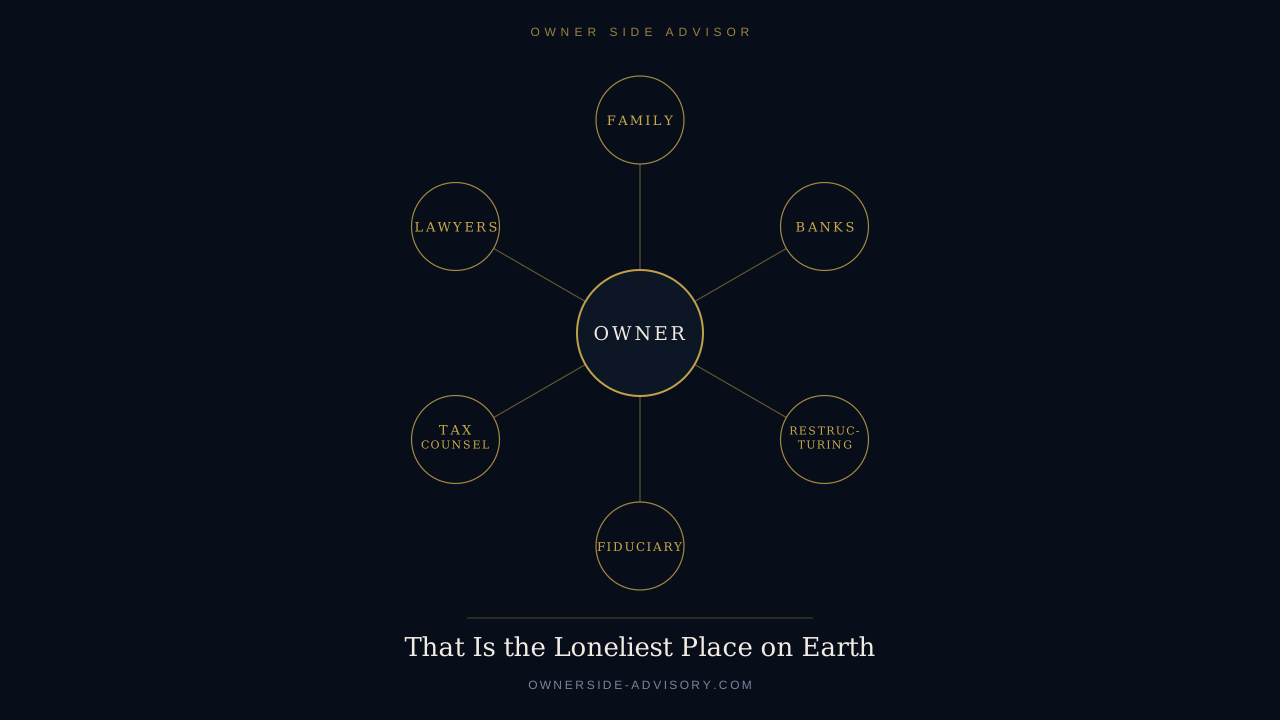
Running a company is hard. Running a family enterprise under pressure is a different kind of hard.
You are not just managing numbers. You are carrying a legacy, managing relatives who all have a stake in the outcome, and putting your own name and assets on the line. That weight does not show up all at once. It builds quietly, and it lands on one person.
Now picture that same person facing a real crisis: family members who do not agree, debts piling up, the business losing money, and lawsuits with their own name attached, not just the company's.
Every part of that mess needs a different expert. A lawyer for the legal risk. A banker for the debt. An accountant for the numbers. A restructuring advisor for the turnaround plan. Each one is excellent in their lane. Each one does their job well.
Here is the problem. None of them see the whole picture. None of them are talking to each other. And none of them are the ones who have to take the lawyer's warning, the banker's terms, and the family's demands, and turn that into one decision by Monday morning.
That job belongs to one person: the owner. On top of actually running the business.
That is the loneliest seat at the table.
Twelve years in that seat
I am not describing a theory. For twelve years, I lived this.
Following my grandfather's passing, I assumed sole responsibility for Grupo Maksoud, a business group with over fifty years of history. I did not create the USD 250 million debt structure, but by signature and name, I inherited the full weight of it. The exposure spanned multiple jurisdictions, complex creditor groups, and deeply sensitive family dynamics. Hundreds of employees, vendors, and family members were counting on decisions I had to make, often with incomplete data and never with enough time.
I had sharp advisors: top-tier law firms, tax specialists, debt restructuring experts. But having brilliant specialists does not solve your problem if nobody is synthesizing what they say.
I remember one stretch where I had a bank on one line asking for a guarantee by Friday, counsel on the other line telling me that guarantee would expose my personal estate, and a family member walking into my office asking why nothing was moving. Three different people, three competing agendas, and only one of us in the room who had to make all three fit together into a single strategy.
Then came a family lawsuit, right when I needed to be fully focused on operations. Then the pandemic hit, the hotel business collapsed overnight, and decisions that should have taken weeks had to happen in hours, with my own name on the line.
Every new advisor you bring in helps with their piece, but if nobody is connecting those pieces, you have not relieved your burden. You have simply added another retainer that requires your time, your context, and your direction.
The governance gap
This is not bad luck, nor is it a personal failure of leadership. It is how the system is built.
Specialists are trained to go deep into one lane. A lawyer thinks about legal risk. A banker thinks about financial risk. None of them are built, or paid, to step back and manage how all the pieces fit together. That is not their job.
And traditional institutional roles rarely fill the gap. A family office manages wealth and investments. A private office handles day-to-day administration. A board sets high-level strategy, but is not in the room for the real-time back-and-forth between five advisors who all need an answer today.
The result is a structural governance gap. Specialties operate in silos; the owner absorbs the friction. Adding more advisors does not close that gap. It widens it.
And while all of this is happening at the office, it follows you home. It shows up at dinner. Your spouse feels it. Your health pays for it. The people closest to you carry a cost that never shows up on any balance sheet, but it is real.
Sitting on your side of the table
After twelve years in that seat, I navigated the group through the storm, resolved the legal conflicts, and protected what mattered. After that, I decided to build a practice around doing for other owners what nobody was positioned to do for me: sit on their side of the table.
Owner-Side Advisory exists for principals facing severe complexity, whether a sale, a debt restructuring, a generational transition, or a crisis where business and family collide.
This is not about adding another layer between an owner and their experts, or creating one more retainer to manage. It is about eliminating the cognitive tax on the principal.
I do not replace your legal counsel, your investment banker, or your accountant. Instead, I sit alongside you to connect the dots across disciplines, filter out the noise, carry the multi-jurisdictional coordination, and ensure that every piece of advice reaching your desk is clear enough to act on quickly.
I bring something standard advisory firms cannot: I have sat in that exact seat. I know what it takes to hold together debt negotiations, lawsuits, and a turnaround all at once under intense pressure. And I know what that seat costs when you have to carry it alone.
An owner who understands their true exposure, aligns their advisory team, and protects their personal balance sheet is not just surviving a crisis.
They are the one who remains standing when the fight is over, with something left to build on.
A conversation
If you are in that seat now
Maybe you saw yourself in this. Or someone you know.
I sat in the owner's chair for twelve years, and nobody sat next to me. Now I sit next to owners who carry the last decision.
It starts with one conversation. You tell me where you are. I tell you honestly if I can help. If I cannot, I will tell you that too.
It stays between us.