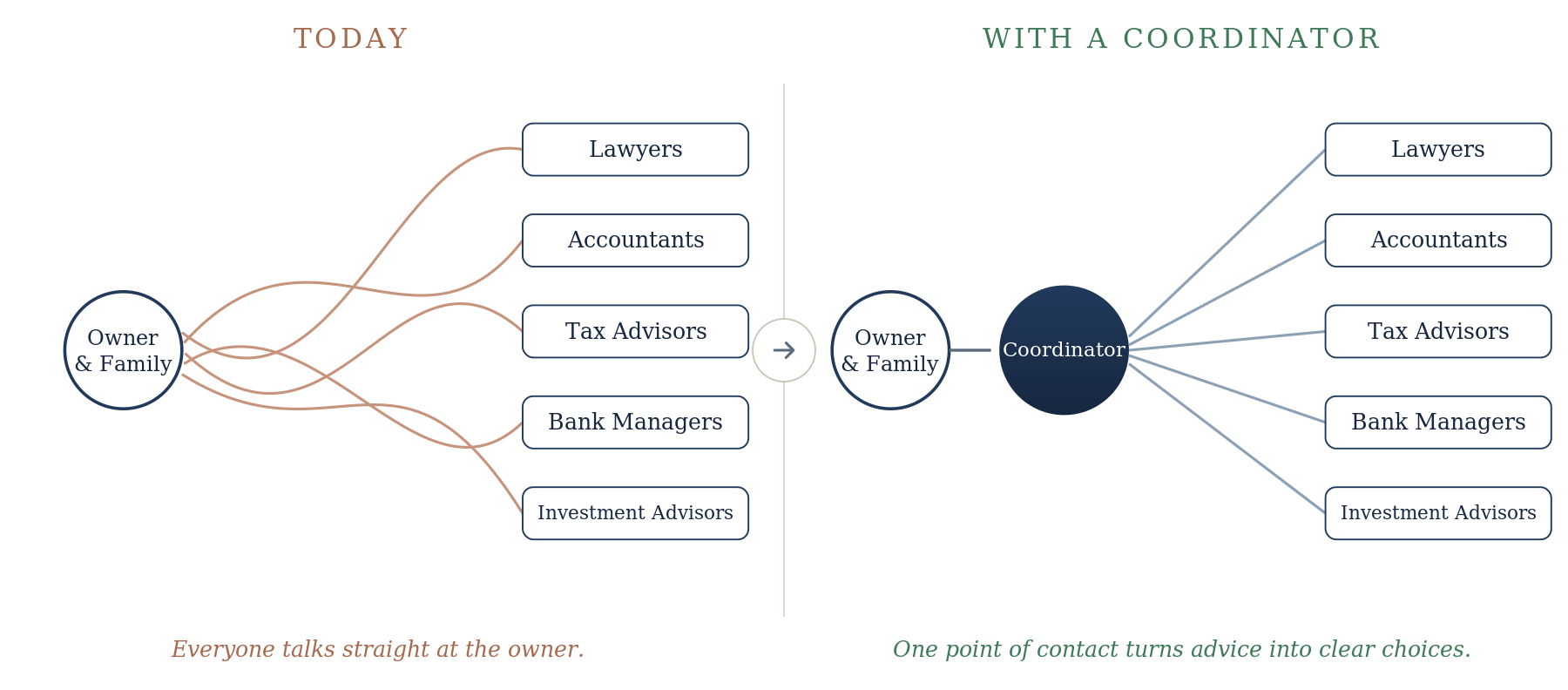
At a recent lunch with fellow business owners, a CEO shared a dilemma that occurs far more often than leaders care to admit:
“We have a massive legal issue in the enterprise that is starting to threaten the family’s personal balance sheet. But we cannot move forward because none of us, including me, can understand what our external lawyers are explaining to us. We simply cannot evaluate the real consequences of the choices in front of us.”
It was a stark reminder of an obvious truth: enterprise owners and founders are trained to build businesses, drive growth, and navigate commercial risk, not to decipher complex, multi-layered legal frameworks or international tax structures.
The trap of legal administration vs. legal strategy
When a family business faces severe legal, financial, or restructuring pressure, many owners assume their internal legal counsel or corporate director will handle it. But there is a dangerous gap between legal administration and principal-level strategy.
Many internal legal directors function primarily as corporate administrators who focus on managing contracts, tracking filings, and keeping the books. In a crisis, however, legal strategy becomes completely intertwined with business survival. You cannot separate a credit negotiation from a bankruptcy statute, nor a tax exposure from a corporate restructuring.
When an enterprise operates across jurisdictions, or within hyper-complex legal environments like Brazil, where civil code, tax tribunals, labor courts, and judicial reorganization layers demand hyper-specialized local counsel, complexity multiplies exponentially. A large crisis can quickly require ten or more distinct niche law firms, each fighting in a different sub-layer of the judiciary.
The breakdown is rarely the quality of individual counsel. Top-tier lawyers do brilliant work in their specific silos. The problem is that nobody in the room is synthesizing their outputs into a single commercial strategy. Different firms issue competing technical opinions, local counsel protects their specific domain, and the owner is left trying to piece together a puzzle where every piece is written in a different dialect.
What a $250 million restructuring taught me
I did not learn this dynamic from a business school case study. I lived it under extreme operational pressure.
While leading my family’s group through a $250 million debt restructuring, a capital crisis four times the size of the operational business, I had to coordinate strategy across 13 distinct law firms across multiple jurisdictions simultaneously.
In a system built on dense civil codes and specialized sub-court layers, having multiple boutique firms was not a choice. It was an operational requirement. But having 13 brilliant firms meant nothing without a unified principal strategy.
That trial by fire taught me a fundamental lesson: specialists do not fail because they lack skill. They stall because external counsel is trained to evaluate legal risk in a silo, while the owner must carry the ultimate commercial and personal risk. If no one sits on the owner’s side of the table to align those advisors, synthesize conflicting opinions, and translate legal friction into strategic choices, the entire enterprise grinds to a halt.
Bridging the gap without breaking the framework
Solving this requires a structural shift. It means removing the cognitive burden of technical synthesis from the owner’s shoulders, while providing external legal counsel with a clear, single-point counterpart on the owner’s side who speaks their language and understands the family’s core priorities.
This is not about replacing lead counsel, making legal determinations, or standing between an owner and their attorneys. Working firmly alongside the client and their legal team, it is about true strategic integration.
That work begins by translating technical legal exposure into actionable, principal-level choices that the family can actually evaluate. It means eliminating advisory friction by synthesizing competing opinions across specialized firms long before board-level decisions are made. Finally, it requires formulating clear operational mandates so that external counsel can execute with speed rather than waiting on client indecision.
When the owner’s side of the table is organized, confusion evaporates, decisions happen with speed, and trusted advisors can finally execute the work they were hired to do.
That is the exact gap I built Owner-Side Advisory to close.
A conversation
If you are in that seat now
Maybe you saw yourself in this. Or someone you know.
I sat in the owner's chair for twelve years, and nobody sat next to me. Now I sit next to owners who carry the last decision.
It starts with one conversation. You tell me where you are. I tell you honestly if I can help. If I cannot, I will tell you that too.
It stays between us.