When people hear what I do, they ask the same question. Why that side of the table? Why sit next to the person who is carrying all the weight, instead of giving an opinion and going home?
Because I know that seat. I sat in it for twelve years, and I know what it does to a person to sit in it alone.
The seat nobody applies for
Your advisors are good. More than good, they are essential. The lawyer protects you legally, the banker works the debt, the accountant closes the numbers. Each one does exactly what you hired him to do, and does it well.
But each one hands you a piece. Nobody hands you the whole thing. By Monday morning those pieces have to become one decision, only one person in the building can make it, and you have to run the company while you do it.
That is not a failure of your advisors, or of your leadership, or of your intelligence, or of your courage. It is simply how the system is built.
Everyone around you is paid to be right about one part. Nobody is paid to hold all of it with you.
My work is not to replace any of them. It is to sit beside you and help those separate parts become one direction.
What that seat cost me
I am not describing this from the outside.
I did not choose that seat. Our family's most important asset went to auction over debts I had not created. My grandfather was carrying that fight, and when he died in early 2014 it became mine: a company with more than fifty years of history, USD 250 million of debt across several countries, and my own name on a good part of it.
And I was on my own inside it. Not for lack of people around me. Almost everyone in the room wanted something different from what I was trying to protect. The creditors were against me, which was their job. The buyers were against me, which was fair. And part of my own family went to court against me, which is the part I never learned to get used to.
That is when an owner finds out what alone really means. Not when the opposition is outside the house. When some of it is inside.
Then the pandemic closed what was still open. Hundreds of people were waiting on decisions I had to take without enough information and never with enough time. For years the work was to keep the thing standing long enough to resolve it properly.
In the end it took a court supervised reorganization. We reached a settlement in 2021 and sold the business in a structured way: the liabilities answered, the dignity intact, the chapter closed on our own terms.
People hear that we sold, and they tell me they are sorry. I understand why. But that is not why I am writing.
I had excellent advisors throughout, and every one of them was right about his own part. Not one of them could sit in the chair with me when the final call had to be made.
What I remember is not the meetings. It is the mornings. The decision was already waiting when I opened my eyes, and it was still waiting when I sat down.
I will not pretend those years were only discipline. There were nights when the weight of it was the only thing in the room with me.
I got through it. But I know what it cost, and I know it did not have to cost that much.
Why I am on this side
That is the whole reason I do this work. Not because I enjoy a crisis. Because almost nobody should face one alone, and almost everybody does.
I am not the hero of anyone's story. The owner is. Nobody can lift the final weight out of that chair, and you should not believe any man who tells you he can. The company stays yours. So does the decision.
What I can do is sit beside you and carry what can be shared: the coordination between the teams, the order of the work, the clarity, and the second opinion at seven in the morning when there is nobody else to say it to out loud.
The crossings
I do not think of these as services. What an owner lives through are transitions, and each one is a different crossing.
If you are selling, I supervise the sale from your side and stay with the bankers and the lawyers every day, so you keep running your business instead of chasing them.
If you are preparing succession, I organize it with the family in the room. Documents say who owns. They never say who is listened to, and both decide whether the plan survives its first disagreement.
If a sale is blocked by old debts and four law firms are sending you four opinions, I turn them into one team working in one order. That is what I am doing today for a private equity firm in Brazil.
If cash is short, I help you buy time and find more cash: what can be collected now, postponed, renegotiated, or sold without touching the heart of the business.
If everything arrives on the same day, the first thing to recover is not money. It is clarity. That is where we start.
Different crossings. The same seat. Next to you.
Finding the harbour
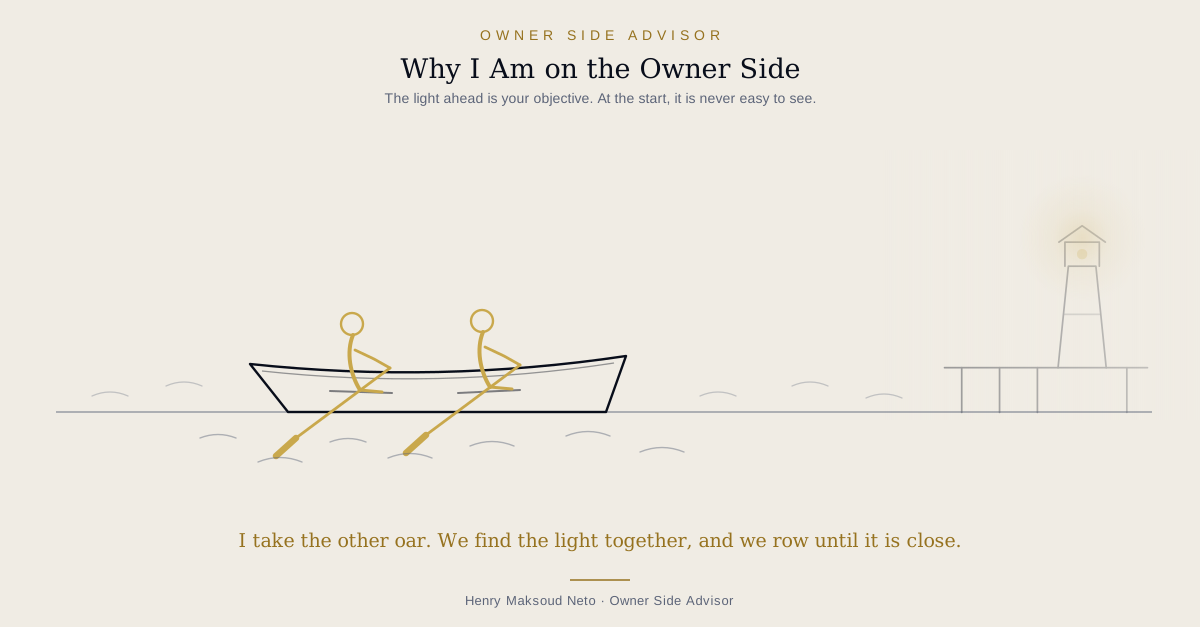
The owner is in a boat, rowing. Ahead there is a harbour with a light on it, and that light is your objective: the sale closed on your terms, the family still speaking at Christmas, the company handed over in one piece, the debt behind you instead of on top of you.
I say objective and not success on purpose. Sometimes there is no clean success available. Sometimes the objective is to lose as little as possible, to protect the name, to keep the family together, to close something with dignity instead of watching it be taken apart. That is still a harbour, and reaching it still takes everything you have.
At the beginning you almost never see that light. It is faint, it is far away, and it is easy to mistake for something else. Finding it is already half of the work.
So I get in the boat and take the other oar. We look for the light together, then we row for it together, in the same rhythm, until it is close enough to be certain.
And the light is real. I reached mine, and mine was not the harbour I would have chosen at the start. For most of those twelve years I was not sure it existed, and it was there the whole time. Owners in worse situations than yours have crossed that water and arrived. You are not the exception.
The boat stays yours. The direction stays yours. Every decision stays yours. I am simply not willing to watch someone row it alone.
I do not bring theory. I bring my own hands. I have signed things I could not undo, I have been wrong, and I have paid for it in full. So when I tell an owner that what he is living can be survived, I am not comforting him. I am telling him what happened to me.
Never give up. Fight for the solution with grit, focus and humility. On the human field, there is always one.
A conversation
If you are in that seat now
Maybe you saw yourself in this. Or someone you know.
I sat in the owner's chair for twelve years, and nobody sat next to me. Now I sit next to owners who carry the last decision.
It starts with one conversation. You tell me where you are. I tell you honestly if I can help. If I cannot, I will tell you that too.
It stays between us.