You have been measured your whole life by how fast you solve problems.
Exams reward speed. Interviews reward whoever answers first. The friend who finished the calculus test in half the time was, everyone agreed, the smart one.
Now look at the people who run things. Some are unmistakably quick and also catastrophic. They decide brilliantly in March and incompatibly in September and never see that the two are connected. Meanwhile the one who asked for a week to think keeps turning out to be right about things that had not happened yet.
If intelligence is speed, none of that makes sense. Either those people are lucky, or we are measuring the wrong thing.
Elliott Jaques spent fifty years arguing that we are measuring the wrong thing.
The question that started it
Jaques was born in Toronto in 1917. He trained in medicine at Johns Hopkins, took a doctorate at Harvard, qualified as a psychoanalyst and helped found the Tavistock Institute in London. He also coined the phrase midlife crisis, which is the only part of his work most people know.
In the late 1940s he was brought into the Glacier Metal Company outside London to settle a pay dispute. Why should a production engineer earn more than an account manager? He spent eighteen months asking people what fair pay would look like, for themselves and for everyone around them. He expected argument. Instead the whole company, top to bottom, agreed about what each role was worth.
Agreed on the basis of what?
Three shop stewards worked it out before he did. Time. Operators were paid by the hour, junior staff by the week, managers by the month, executives by the year. The pay period was tracking something real that nobody had named.
The hidden number in every job
Take any role and ask what the longest task is, and when it is due. Not tomorrow’s meeting. The longest one, the one nobody can yet judge.
Jaques called it the time span of discretion. It is how long you work on your own judgement before the result comes in. A technician might close everything within a day. A purchasing manager needs three months to land a contract. A chief executive may be holding a decision whose consequences stay invisible for fifteen years.
Measure that and you have measured the weight of the role. It turned out to be exactly what people were using when they judged what pay was fair. He and his colleagues then tested it for thirty years, in companies, in government, and in the American and Australian armies.
What IQ asks, and what it never asks
An IQ test asks how fast and how accurately you handle a problem somebody else has already defined, in a room, in an hour. It measures that well. It is also the only mental measure most of us are ever given, so we have let it stand in for the whole mind.
Jaques asked something else. How far into the future can you hold an intention, and how much interacting complexity can you carry while you hold it?
Those are not the same ability. Solving a hard technical problem is speed inside a fixed frame. Seeing how a system will behave in two years, after five forces you cannot yet measure have acted on each other, is holding a frame that will not stay still.
His definition of work makes it obvious. Work is the exercise of judgement where the answer is not available. If the answer is available, it is not work. It is execution. An exam hands you problems whose answers already exist. Almost nothing after school does.
None of which means the test measures nothing. It measures something real, and people who score well do better across a wide range of work. That has held up for decades. Horizon and processing power are not rivals and probably travel together. A long horizon with nothing behind it is not vision. It is daydreaming.
The claim is narrower. A score tells you about the engine and nothing about the distance. We use it to decide distance because it is the number we happen to have.
That is the question IQ never asks. Not how quickly can you answer, but how long can you stay out there deciding, before anyone can tell you whether you were right.
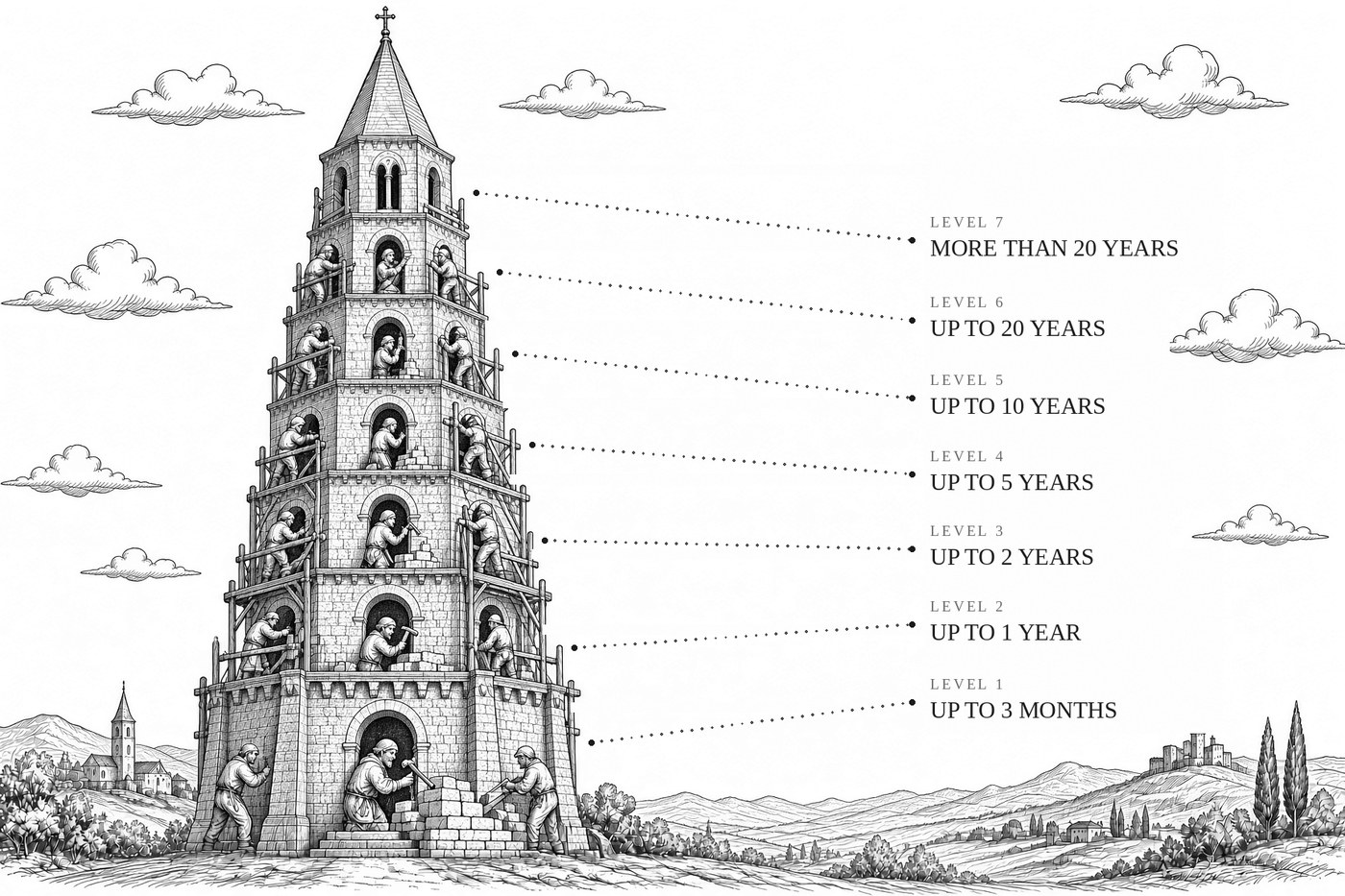
The numbers cluster. Between one cluster and the next the work changes in kind, not only in size. Jaques mapped seven bands.
| Level | Time horizon | Typical role | What the work is |
|---|---|---|---|
| 7 | More than 20 years | Institution builder | Sets direction for decades |
| 6 | Up to 20 years | Group chief executive | Builds long term position |
| 5 | Up to 10 years | Chief executive | Owns strategic intent |
| 4 | Up to 5 years | Senior executive | Change and continuity |
| 3 | Up to 2 years | Function head | Designs systems and practice |
| 2 | Up to 1 year | First line manager | Coordinates the year |
| 1 | Up to 3 months | Front line | Delivers the task |
Levels 1 to 3 run the business. Levels 4 and 5 build its future. Levels 6 and 7 shape the institution.
What each person sees
The old fable has three men cutting stone. One says he is cutting stone. One says he is earning bread for his children. One says he is building a cathedral.
It stops at three. Carry it to seven, because a cathedral needs all seven, and because what separates the levels is not effort. It is what each man sees when he looks up from his hands.
Level one. He sees the stone in front of him. He knows a true edge before his mind does. If this stone is wrong, the wall is wrong. He finishes it today.
Today The nurse on the ward, the electrician, the technician who keeps the machine running. The task and its limits are largely defined before you arrive. The judgement is in doing it right.
Level two. He sees the yard for the season. Twelve cutters kept supplied, the sick one covered, the wrong load from the quarry dealt with. Nothing in the rulebook covers today, so he decides.
Today The shop supervisor, the head nurse, the owner of one small shop. Holding a year together so that many days add up to something.
Level three. He sees the wall rise across two winters. Not this week’s stones, but how stones will be laid, and whether mortar that works in summer will hold in frost. He designs the practice.
Today The operations director, the department head, the serious specialist. The question moves from how do we handle this, to what system would stop it happening.
Level four. He sees the finished nave while standing in an unfinished one. Half the building is in use, half exists on paper, and the money and the men must be split between them. He starts what will not be judged for years and stops what still works.
Today The senior executive. The hardest step, and where most careers stall. Many fine operators are promoted into it and never told the work has changed shape.
Level five. He sees a cathedral that does not exist. No stone laid. The whole thing is in his head, ten years out, and everything that follows is an argument with his drawing.
Today The chief executive. Markets, capital, reputation, and the shape the company needs when the current model runs out. Operational detail stops being an input, provided somebody capable now owns it.
Level six. He sees the city the cathedral will change. Where the roads run, what the square becomes, which trades move in, whether the town can feed the people it draws.
Today The group chief executive. Several businesses on different logics, under conditions that will have changed before the results arrive.
Level seven. He sees what the cathedral is for, after everyone alive is dead. He will never see it finished. Neither will his children.
Today Very few roles. The institution itself and its survival beyond the people running it. In a family enterprise this is where succession actually lives, and why it never settles inside a two-year plan.
Effort does not change across the seven. Skill does not. Care does not. What changes is how far ahead the person is holding something, and how much is moving while they hold it.
Two rules make the ladder work. A manager sits exactly one level above the people reporting to them, never two. Stack two of the same level and you get a boss with nothing to add who fills the day interfering. Leave a gap of two and you get a chief speaking in five-year terms to a team hearing a demand for Monday morning. The second rule is harder. The manager is accountable for the results of the people below, not merely for supervising them. If your subordinate fails, you failed. That is what stops this becoming a sorting machine.
Where most of us are
The levels are not evenly populated. Nothing like it.
Marcos Bruno, of Instituto Pieron in São Paulo, has spent years assessing people against this framework in Brazil. He observes that well-managed companies generally have little difficulty staffing roles at levels one through three. The constraint becomes more evident at the transition from level three to level four, where even strong companies struggle to find people able to sustain that complexity. People capable of sustaining work at level five are rare; level-six capability is rarer still.
Read that as bad news and you have it backwards.
It means the cathedral is built almost entirely by people at levels one, two and three. The hospital that treats you, the grid that lights your house, the aircraft that stays in the sky. If you are one of them you are not waiting at the bottom of something. You are the part of the structure that carries the load.
It also means many organisations have filled four and five with people who cannot hold them, because the chairs exist and somebody has to sit in them. They are not frauds. The chair is larger than anyone the company could find. That is why senior teams look busy and decide nothing, and why strategies die eighteen months after they are announced.
And it explains a private experience. Someone who genuinely holds a four or a five will spend years in roles too small for them, being called difficult, impatient, not a team player. They are carrying a horizon the job has no use for.
The distribution is not a ranking of human beings. Rarity and worth are different things. Gold is rare. Water is not. You will die without one of them.
One name everybody knows
If this still feels abstract, take the example Marcos Bruno uses when he teaches it.
In 1983 Steve Jobs spoke at a design conference in Aspen. The Macintosh did not exist. Almost nobody in the room owned a computer.
He said Apple wanted to put a great computer inside a book you could carry and learn in twenty minutes, with a radio link so it plugged into nothing. That is the iPad, twenty seven years early. He said people would one day walk around Aspen collecting their messages on portable computers with radio links. He said software would be bought by sending tones down a phone line from one machine to another, which is the App Store. He described an MIT truck that had photographed every street in Aspen into an electronic map you could walk through, which is Street View, twenty four years early.
Two years later, asked why anyone should spend three thousand dollars on a home computer, he said the real reason would be connecting it to a nationwide communications network, as important a breakthrough as the telephone. Asked what it would be used for, he said he could only begin to speculate.
That exchange is the whole thesis. He did not know. He could not name a single application. He was certain about the shape of something a decade away, and spent the decade acting on it without proof while everyone asked for specifics he did not have.
That is what a long horizon is. Not smarter, not faster. Holding an intention steady for years while conditions change, with no evidence until long after the decision had to be made. Level one finishes the stone and knows by tonight. Level seven decides what the cathedral is for and dies before anyone can say.
The obvious objection is that I picked a man who was right, and the graveyard is full of ten-year convictions that lost everything. But look at what killed most of them. The idea was not wrong. The execution was. Kodak built the first digital camera and could not bring itself to sell it. Nokia had smartphones years before Apple. Both saw the future. Neither built the organisation that could reach it.
That is the ladder, not an exception to it. A vision at five is worth nothing without a four who can carry the building and a three who can turn it into practice. A long horizon on a structure that cannot carry it is not a strategy. It is a wish. And a horizon tells you how far out a person holds a decision, never that the decision is right. Jobs lived both sides. The Lisa failed, he was removed from his own company, NeXT never sold in numbers. What changed later was not the length of his view. It was having an organisation that could deliver it.
Jobs never argued that the machine was the point. His favourite fact about computers came from a study of how efficiently animals move. The condor won. Humans placed poorly. Then somebody measured a human on a bicycle, and the human beat the condor outright. That is why he called the computer a bicycle for our minds. He was not sorting humanity into grades. He was handing out bicycles.
A level is not a measure of worth
Read carelessly, the fable makes the third man the best one. Somebody has to cut the stone, and cut it perfectly, or there is no cathedral. The seven answers describe how far ahead each man holds an intention. They do not say who is the better man.
A surgeon works in hours. A teacher works in a school year. The nurse who catches what nobody else caught, the technician who keeps a plant from failing, the craftsman whose hands know what no manual contains, none of them is waiting to become something else. They are doing the work, at the size the work is, and the world runs on it.
The reverse matters as much. A long horizon is not a virtue. It is a capability, and capability is morally empty. Some of the most destructive people in history held plans across decades and saw exactly how systems would interact. That is what made them dangerous. Jaques judged any design by one test. Does it increase trust, or does it increase suspicion.
He was careful with his own method, refusing to publish his assessment technique because he expected consultants to buy it and start labelling people who had no say in the matter. He has been called rigid, mechanistic and worse. Compensation bodies refused to endorse him. Some schools kept him off the syllabus. The objection is serious. Any framework describing differences in capability can be used to trap people in a category.
Nor is it an excuse for failed executives. Capability is necessary and nowhere near sufficient. Jaques said a managerial leader needs the complexity to match the role, plus a real valuing of the work itself, knowledge and skill with actual practice in both, wisdom about people, and the absence of temperamental characteristics that wreck working relationships. Capability is one item on a list of five. A founder who will not build governance, will not delegate and will not listen may have all the horizon in the world and fail on the other four.
You are not where you will stay
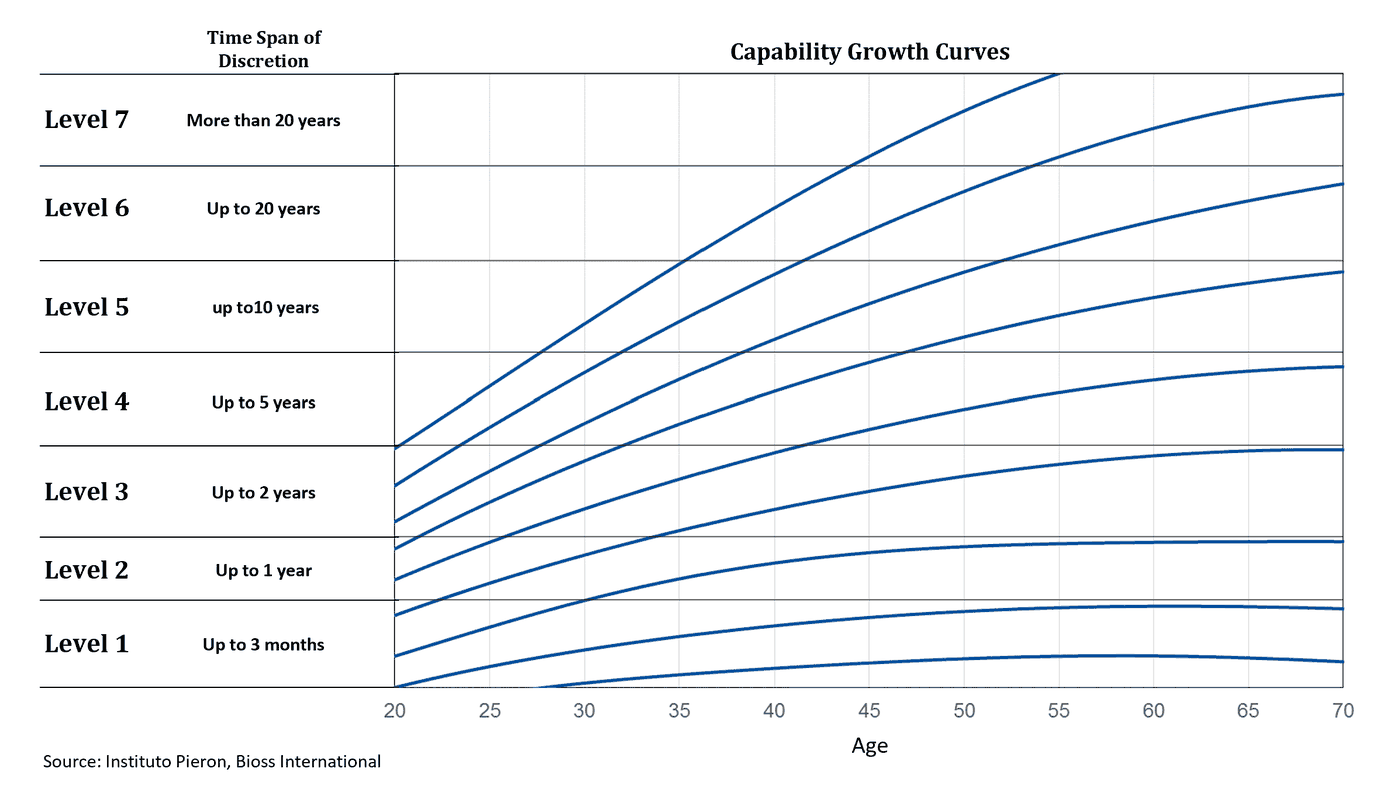
Capability is not fixed when you finish school. Jaques found that it continues to mature throughout adult life along distinct, broadly predictable trajectories. People begin at different points, grow at different rates, and reach different eventual levels. They do not follow the same curve, and they do not converge on the same destination. But nobody remains where they began.
Two ways to be in the wrong place
Ask the question directly. What is the longest thing I am carrying, and when is it due? Then the harder one. Is the work bigger than I can hold, or smaller?
Both get mistaken for character. Too big produces a quiet, permanent fear of being found out. The person stays for the salary and avoids decisions, because every decision exposes them, and the organisation fills with things that were never settled. Too small produces someone difficult and political, obsessed with what the people above should be doing. Everyone reads that as arrogance. It is closer to claustrophobia.
I did this to people more than once, before I understood any of it. I would take someone excellent at executing and put them in a role that required them to think two years out, and then watch them stop sleeping and start carrying it in their body. I thought I was rewarding them.
They rarely recover the role. Usually they leave, and it gets recorded as a resignation.
Neither is a flaw of personality. Both are mismatches, and mismatches can be fixed.
One warning before you place yourself. The most comfortable conclusion available here is that you work at a high level and should not be troubled by daily detail. That conclusion is available to anyone, and it is wrong more often than it is right. So there is a test, and it is not a matter of opinion. You may let go of operational detail only if a named person directly below you is genuinely accountable for it and genuinely able to hold it. Name them. If you cannot, you have not risen above that level. You abandoned it, and the work is still there, being done badly or not at all.
A second test. Anyone working at a long horizon can describe what they are building over ten years in terms specific enough to be proved wrong. Vagueness is not a horizon. It is avoidance wearing the clothes of one.
What it costs when nobody names it
An owner wins an order worth most of his annual output. He buys the machines and hires the operators, but builds no maintenance system, delegates no financial authority, and puts nobody between himself and the floor. Within a year the quality slips, the old customers leave and the company is gone. He was not stupid. The work in front of him changed level and he did not.
In family enterprises the same thing arrives in disguise. It gets called a family conflict, or politics, or a difficult relative. Usually it is a design problem. A large title sitting on small complexity, or a capable person parked where their judgement has nowhere to go. Until somebody names the real problem, the family keeps arguing about people.
Why I am writing this
Jaques wrote for specialists, and his ideas reached companies through human resources departments and consulting firms. Seventy years of using the framework to organise people, and almost no time offering it to a person as a way to understand their own life.
That is backwards. This is not a management tool. It is a mirror. It tells you the size of the work you are carrying, which is not your title, your salary, or how fast you finish things. It lets you stop asking whether you are good enough and start asking whether the work fits.
Elliott Jaques was a genius, and he is mostly forgotten. I think that is a loss, and not only for companies.
What my IQ could not see
I failed three years of school.
Brazilian teaching is built on memorising. Formulas, dates, definitions, reproduced on demand. I could not do it. I still cannot. I would study for a week and arrive at the exam with nothing where the information was supposed to be.
At fifteen I took an IQ test. I scored below average.
I am not going to soften that. It was not a borderline result and it was not close to the middle. The test was not broken and it was not unfair. It measured what it measures, and on that thing I was genuinely below most people my age.
Nobody in the room offered any other explanation, so I took the only one available. I decided I was not intelligent. I stopped arguing with it. That belief lasted about twenty years, and it cost me far more than the failed school years ever did.
Later I applied to the trainee programmes at the large banks, which in Brazil are the standard door into a serious career. The selection runs on timed reasoning tests. I did not get through. The rejection did not feel like new information. It felt like confirmation.
Here is what took me two decades to see. Most of the owners and entrepreneurs I have worked with since would not have passed those tests either. Not a few. Most. These are people running real companies, employing hundreds of families, carrying decisions whose consequences arrive ten years later. They would have been filtered out in the first hour, by an exercise measuring how fast they complete a pattern.
That is not an argument that the test is worthless, or that the people who score well are lesser. Many of them are excellent and their work is real. The point is narrower and harder to escape. The test measures one thing accurately, speed and precision on problems that already have answers, and then we use it to decide something much larger than it can see. It cannot tell you whether a person can hold a decision for five years with no evidence that they were right. It cannot tell you whether they will still be standing when the answer finally comes. My score was probably correct about what it tested. It said nothing about whether I could hold a company together through eleven years of litigation, a pandemic, and a liquidation, because nobody thought to ask that question, and no test I ever sat could have answered it.
What changed things was the Work Levels process at the Instituto Pieron. It did not tell me I was clever, and I would not have believed it if it had. It told me the size of work I can hold. It told me how to direct that work instead of copying leaders built differently from me. It told me who I work well with and who I do not. And it told me what I should never take on, which is the most useful thing anyone has ever told me and the thing nobody teaches.
It replaced a verdict with a description. That is the whole difference.
That is why I write about Elliott Jaques.
One thing has stayed with me since. Listen to anyone who genuinely matters, in business or in government, and notice that they almost never perform a calculation. They talk in spans. They describe how something will move, what will act on it, where it ends up. Geopolitics is this. Wars are this. The artists who changed anything were rarely the most skilful of their generation, they were the ones who saw where the form had to go next. Whatever we build with these new machines will be decided the same way, by people who can see what a moving system does before the rest of us can.
We have no measure for that. We test for speed, because speed is easy to test, and then we hand the largest decisions of our age to whoever was quickest in a room at eighteen.
I was measured at fifteen and the measurement was correct. It simply had nothing to do with what I would spend my life doing.
Henry Maksoud Neto
Where to learn more
The Work Levels methodology is available in Brazil through the Instituto Pieron, in São Paulo. Founded in 1959, Instituto Pieron brought Elliott Jaques’ work to the Brazilian market and is part of Bioss International, founded by Jaques in London in 1963. They run an introductory course, Work Levels Fundamentals, and an overview of the model at pieron.com.br/work-levels.
Instituto Pieron
Rua Dr. Amâncio de Carvalho, 182
Win Work Ibirapuera, conj. 608
São Paulo, SP, 04012-080, Brazil
Telephone: (11) 5573-9688
pieron.com.br
Enquiries Monday to Friday, 8:00 to 18:00.
A conversation
If you are in that seat now
Maybe you saw yourself in this. Or someone you know.
I sat in the owner's chair for twelve years, and nobody sat next to me. Now I sit next to owners who carry the last decision.
It starts with one conversation. You tell me where you are. I tell you honestly if I can help. If I cannot, I will tell you that too.
It stays between us.