I am writing this for two people. The owner who is planning his succession, and the one he has chosen. They are about to live through the same event and they will not see the same thing. What follows is what I learned in that seat, and what I would say to each of them.
It was his personal assistant who called me.
That was the beginning of 2014. My grandfather had died. I was a partner in the company, never its owner. The decisions were mine, from that morning on, and so was two hundred and fifty million dollars of debt I had not created.
I want to go back and tell you how a person arrives at a morning like that, because almost nobody plans for it, and every family I now work with is somewhere on the same road.
The company I grew up inside
I started working at sixteen, in 1991, as an assistant cook. I had no idea what I would become. I only knew the family had a company and that I was inside it.
My grandfather founded that company in the late 1950s. By the time I was old enough to understand it, it was already weak.
It had been a brutal engineering business. More than ten thousand employees. Airports, dams, roads and telecommunication systems, across Brazil, Europe, Latin America and Central America. By the 1990s all of that was in decline.
The group had other businesses too. Hotels, cattle farms, computer hardware, publishing. One by one they were closed, or sold to pay debts, or scrapped.
By the end there was one company still operating, and it was carrying the weight of everything else. The Hotel Maksoud Plaza, in Sao Paulo.
The man who called me back
In 1997, as an undergraduate economics student, I started working at Merrill Lynch, in the private banking office in Sao Paulo. A year and a half later they offered me a permanent job.
My grandfather called me back.
He raised me, after my parents divorced. He was a short man and an extremely demanding one. Inside his company he demanded a great deal, and he got it. I know, because I had worked for him.
But in 1997 I was not his employee. I worked for a bank. He had no authority over me at all, and he knew it. So he did not give me an order. He persuaded.
He was one of the most persuasive people I have ever met, and I have spent my whole career in rooms full of persuasive people. What he said to me that day was not an instruction. It was a case, made carefully, by a man who knew exactly which sentence would land.
“You prefer to make the bankers rich than to work for your family.”
“I built these for you and nobody cares.”
Then I asked him a question. What will happen if the company fails, because it is already failing.
He answered:
“You will begin with more experience.”
I have mixed feelings about that today. Whether he was being selfish, or whether he wanted me to become someone strong, trained by his values, who might one day do great things.
I quit the bank. One year later I was the only family member in the business.
Understand what had happened there. He did not order me home. He convinced me to choose it. That distinction mattered very little to me at twenty-three. It matters enormously to me now, and I will come back to it at the end.
The years nobody counts
That is where most succession stories would end. The successor comes home, the founder hands over, the family is served. Mine did not work that way. It was eleven more years before anything was handed to me at all.
For those years I was director of operations of the group, reporting directly to my grandfather.
That is the position most successors are in, and it is worth naming. I ran the operations. I did not hold the debt. I knew the business in detail and I did not know the exposure, because the exposure was not part of my job. It was part of his.
2011
In 2011 the building the hotel stood in, which the group owned, was placed under legal action to pay debts of the holding company. Our family’s most important asset went to auction, over debts I had no part in creating.
I was not the Principal. My grandfather held that seat and the fight was his to lead. But I remember exactly where I was when I understood that something had shifted in me. From that day on, this could not be someone else’s fight. It had to be mine too.
By then the company was in great debt and had been living by selling itself. Buildings, land, brands, sold one at a time to pay what was owed.
The hotel was the only operating company left. Even a successful turnaround there could not cover what the group owed. I could see that much.
What I could not see was the total. It was not clear to me, and I am not certain it was clear to anyone.
Early 2014
Which brings me back to the phone call.
There was no plan. There had been one conversation, thirteen years earlier, and you have already read what was said in it.
What arrived that morning was this. A company with more than fifty years of history. Two hundred and fifty million dollars of debt, spread across several countries. And my own name on a good part of it.
I did not build that debt. But by signature and by name I had inherited the whole weight of it. There was tax owed at federal, state and municipal level, built up over years, close to ten times what the group earned in a year. There were creditors who did not agree with each other. There were hundreds of employees and suppliers waiting on decisions I had to make with incomplete information and never enough time.
And I was alone inside it. Not for lack of people in the room. Almost everyone in that room wanted something different from what I was trying to protect. The creditors were against me, which was their job. The buyers were against me, which was fair. And part of my own family went to court against me, which is the part I never learned to get used to.
That is when a man finds out what alone really means. Not when the opposition is outside the house. When some of it is inside.
It took until 2021 to reach a final agreement. Ten years.
The thing I did not understand until later
He told me the truth. That is the part it took me years to see.
He did not pretend the company was sound. I asked him directly and he did not deny it. He simply had no plan to offer, and he believed what he had instead was better. Difficulty. Character. The thing he had been given himself.
He was honest, and I was not prepared. Those two things have almost nothing to do with each other.
A succession can fail without a single lie being told. A successor cannot act on a sentence. He can only act on a list of what has been signed, a real number, and the name of someone to call. My grandfather gave me a sentence. It was true, and on the morning of the phone call it was worth nothing.
He said he built it for me, and that nobody cared. He was wrong about that. I left the bank and gave twenty years of my life to it. I knew it was bad and I took it anyway. What I did not know was the real number, and I found that out only when the decisions were already mine.
To the owner who is planning it
You are making two decisions, not one. Who takes it, and what you put in his hands. Almost every owner I have met has made the first one carefully and the second one not at all.
Being honest is not the same as preparing him. You can answer every question truthfully and still hand over nothing he can use.
You are the only person alive who can add up the number. In a family company the liabilities build quietly, across tax, labour and personal guarantees, and the person best placed to know the total is the person who created it. That is exactly why it has never been written in one place. It will be added up eventually. The only question is whether that happens on your terms, or by someone sitting across the table from your successor.
Hardship is not information. It may well build the man, and I will say something about that at the end. But no amount of difficulty tells him where the guarantees are.
If the company is in trouble, you are not handing over a company. You are handing over ten years of somebody’s life. He is entitled to know that before he answers.
And what you spare him by not telling him, he will meet anyway. Later, alone, with fewer options than you have today.
To the one who has been chosen
Before you say yes, ask for one page. Everything that has been signed, by whom, and for how much. Most owners cannot list their guarantees from memory, and that is not dishonesty. It is what happens when every obligation was reasonable on the day it was taken.
Ask where your name is going, and for how much, before it is there.
Then learn to read the balance sheet, and read it yourself. Not a summary of it, and not somebody’s explanation of it. The numbers. If you cannot read one yet, learn before you accept, because from the day you accept every figure you are shown will reach you through someone who has a reason to shape it.
I knew that business better than almost anyone working in it. I could not have told you what it owed.
Understand the size of what you are accepting. It may not be a job, and it may not even be a company. It may be a decade.
You can love the man and still refuse the terms. Those are two separate answers, and most of us never realise we were allowed to give them separately. I did not.
If you do say yes, do not do what I did. Do not carry it alone, and do not pretend at home that everything is fine. I hid it for years, because I did not want my family to carry more than they already were. That instinct comes from love, and it means three people can be lonely in the same house at the same time, each one alone in a different way.
Move early. The arithmetic of time is brutal. A problem confronted at month three offers ten viable paths. The same problem at year three offers two, and both of them hurt.
The conversation to have while there is still time
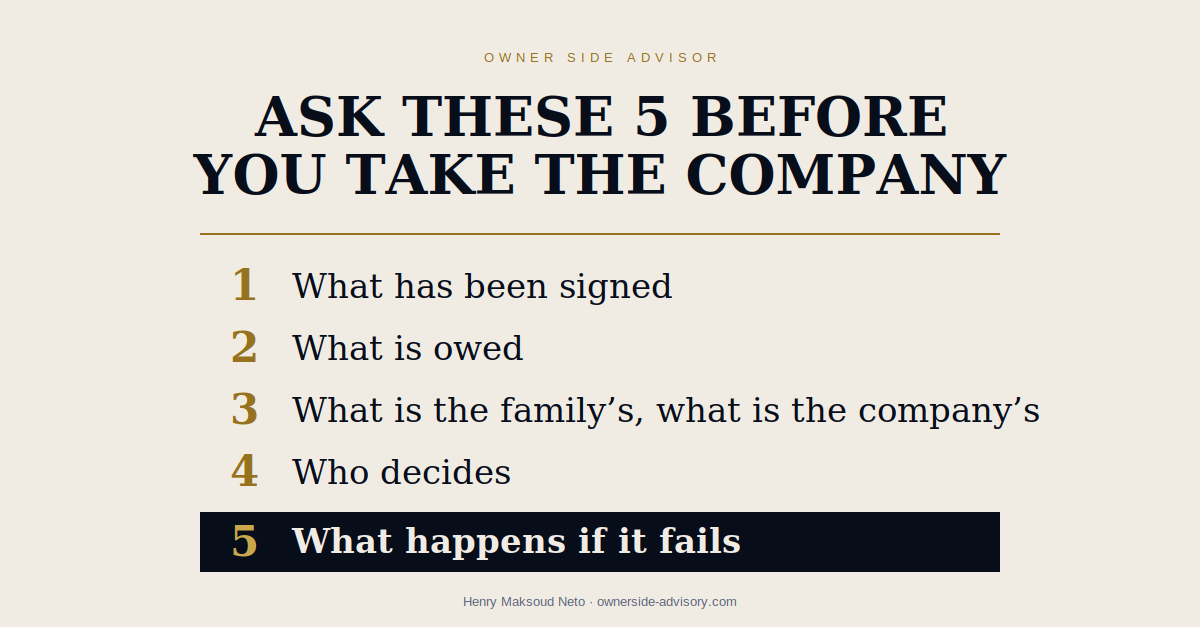
If you read nothing else here, read this. Sit down together, with paper, and answer five questions. Not in feelings. In writing.
What has been signed, by whom, and for how much.
What is owed, to whom, and by when.
What belongs to the company and what belongs to the family, and where the wall between them has a door in it.
Who decides what, from the first day.
And what happens if it fails.
That last one is the question I asked my grandfather when I was twenty-three, standing in front of him with an offer from a bank in my hand. It is the right question. It deserved a better answer than the one I got, and a better answer than the one most families give, which is silence.
Answer it properly and the family can survive the business failing. Leave it unanswered and the business takes the family with it.
The answer I would give him
Everything I have written here is a criticism of what he did. He handed me a sentence instead of a number. I have spent twenty years paying for that, and I now spend my working life making sure other owners do not repeat it.
So a reader is entitled to ask why I am not bitter.
Here is the answer. He never ordered me home. He persuaded me, and I chose. And having lived it, I would choose again.
I had very hard years. I would still rather have my life, with those years in it, than the life of a man who inherited everything in perfect order and is miserable in his own house. The difficulty took a great deal from me and it also made me. I know exactly what I am capable of, and I did not learn that at the bank.
“No man is more unhappy than he who never faces adversity. For he is not permitted to prove himself.”
Seneca
So my grandfather was half right, and being half right is the most dangerous thing a founder can be. He was right that adversity makes a man. He was wrong to think it was enough. A successor needs both. The character to carry it, and the numbers to fight it with. He gave me the first and kept the second, and I do not believe he did it to hurt me. I believe he never wrote the number down because he could not bear to look at it himself.
Give your successor both. He will be grateful for the numbers, and the adversity will arrive on its own.
I would quit the bank again, if it was needed.
A conversation
If you are in that seat now
Maybe you saw yourself in this. Or someone you know.
I sat in the owner's chair for twelve years, and nobody sat next to me. Now I sit next to owners who carry the last decision.
It starts with one conversation. You tell me where you are. I tell you honestly if I can help. If I cannot, I will tell you that too.
It stays between us.